How to Forecast Stock Prices a Practical Guide
Learn how to forecast stock prices with our guide on fundamental, technical, and AI-driven methods. Gain practical insights to improve your market analysis.

Forecasting a stock's price is all about using what we know historical data and market trends to make an educated guess about where it's headed. The sharpest investors I know don't just stick to one method, like fundamental analysis or technical analysis. They combine them, often with the help of AI-driven models, to build a solid framework for their decisions.
Foundations of Stock Price Forecasting

First things first: let's get one thing straight. Nobody can predict the market with 100% accuracy. If they could, they wouldn't be sharing their secrets. The real goal isn't to find a crystal ball for guaranteed wins; it's to stop guessing and start analyzing. This guide breaks down the core methodologies that professional analysts use to get a handle on market dynamics and spot potential shifts before they happen.
To get good at this, you need to be comfortable with a few key pillars of analysis. Each one gives you a completely different lens for viewing a stock's potential.
The three main approaches you'll encounter are:
- Fundamental Analysis: This is all about the 'why' behind a stock's value. You're digging into the company's books, checking out its leadership, and sizing up the competition to figure out what the business is actually worth.
- Technical Analysis: This focuses more on the 'when' by studying chart patterns, trading volume, and market stats. The whole idea here is that collective market psychology and past trading activity can give you clues about future price moves.
- Quantitative and AI Models: This is the modern playbook. It uses powerful statistical models and machine learning to uncover complex patterns in huge datasets—the kinds of signals a human analyst might completely miss.
To give you a clearer picture, here’s a quick breakdown of how these methodologies stack up against each other.
Core Forecasting Methodologies at a Glance
Each of these approaches brings something unique to the table, and the most robust strategies usually borrow elements from all three.
The Human Element in Forecasting
Even with all the sophisticated tools at our disposal, forecasting is still a mix of art and science. That human element—our biases, our emotions, our herd mentality—can throw off even the most data-driven predictions. The data on expert performance is pretty humbling.
A massive study by the CXO Advisory Group looked at 6,584 forecasts from market gurus and found the overall accuracy rate was just under 47%. That's right, basically a coin flip, and slightly worse at that.
So, does this mean forecasting is a waste of time? Not at all. It just proves you need a disciplined strategy that accepts uncertainty as part of the game. The principles behind financial forecasting show up in other areas, too. For example, there are interesting parallels in understanding the impact of real-time payments on financial planning and forecasting.
The best investors I've worked with don't just make predictions; they prepare for multiple possible outcomes. That's the real secret.
Finding a Company's True Value with Fundamental Analysis

Before you can make a solid guess about where a stock is headed, you have to know exactly where it stands right now. That's the entire point of fundamental analysis: digging deep to figure out a company's real, underlying intrinsic value.
Forget the day-to-day chart squiggles and market chatter for a moment. This approach is all about looking at the business itself. Is it making money? Can it keep its rivals at bay? Is it actually growing? Getting answers to these questions builds the bedrock for any smart long-term investment.
Diving into the Financials
Your first port of call will always be a company's financial statements. Think of these as the official report card on a business's health. You don't need to be a CPA, but getting comfortable with the three main reports is non-negotiable.
- The Income Statement: This shows you if a company is profitable over a set period, like a quarter or a year. It lines up revenue, subtracts all the costs, and gives you the famous bottom line: net income.
- The Balance Sheet: This is a snapshot in time of everything a company owns (assets) and everything it owes (liabilities). The difference is what's left for the owners shareholders' equity.
- The Cash Flow Statement: Many pros consider this the most honest of the three. It tracks every dollar that actually came in or went out. It’s a lot harder to fudge real cash movement than it is to play with accounting rules.
These documents are where you'll find the raw ingredients for your analysis. For example, by pulling up the last few income statements, you might spot that revenue has been climbing at 15% year-over-year a very healthy sign.
Key Metrics That Tell a Story
Raw numbers are just that—raw. The real magic happens when you turn them into ratios that let you compare a company to its competitors or even to its own past performance. These metrics are the language of fundamental analysis.
Here are a few you absolutely have to know:
- Price-to-Earnings (P/E) Ratio: This classic ratio pits the company's stock price against its earnings per share (EPS). A high P/E could mean the stock is pricey, or it could signal that investors are betting on explosive future growth.
- Earnings Per Share (EPS): Simply the company's total profit divided by the number of shares out there. A business with a history of steadily rising EPS is usually a healthy, expanding one.
- Return on Equity (ROE): This measures how well a company is using its shareholders' money to generate profits. An ROE consistently above 15% is often the mark of a high-quality operation.
You can't just look at one metric in a vacuum. A stock with a low P/E might look like a bargain, but if its EPS is shrinking and ROE is in the gutter, you could be walking into a classic value trap. That's a stock that's cheap for a very good reason.
Beyond the Numbers: Qualitative Factors
A truly great forecast goes beyond what you can find in a spreadsheet. Some of a company’s most valuable assets don't show up on the balance sheet. These are the qualitative factors, and they are every bit as important.
Just think about a powerhouse like Apple. Sure, its financial reports are stellar. But a massive part of its value comes from its unshakable brand loyalty, its culture of innovation, and its long history of visionary leadership. You can't put a number on that.
To get the full picture, start asking these questions:
- Competitive Advantage: What's the company's "moat"? Does it have a killer brand, a portfolio of patents, or a network effect that makes it nearly impossible for competitors to catch up?
- Management Quality: Is the leadership team seasoned, credible, and transparent? Do they have a clear plan for the future, and more importantly, do they have a history of delivering on their promises?
- Industry Trends: Is the company riding a growing wave, or is it fighting against a tide of technological disruption and shifting consumer habits?
Ultimately, fundamental analysis gives you the "why" behind an investment. It lets you build a case based on tangible business performance and potential, giving you the conviction to stick with your decision even when the market gets choppy.
Reading Market Sentiment with Technical Analysis
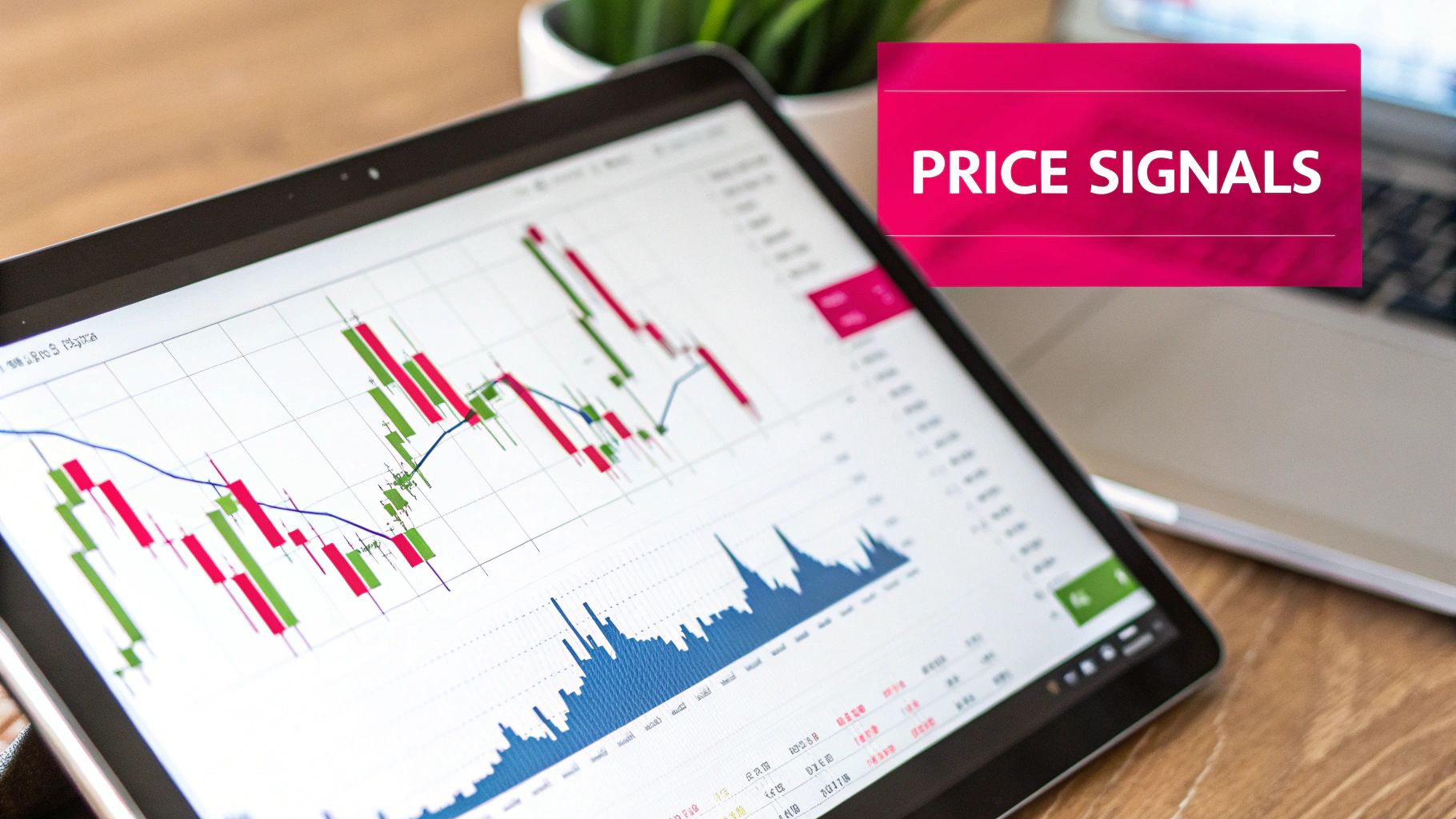
If fundamental analysis tells you what to buy, technical analysis is all about figuring out when to buy it. The core idea is simple: all the news, earnings reports, and investor psychology are already reflected in a stock's price chart. Those squiggly lines aren't random noise they're the collective footprint of human fear and greed.
Learning to read these charts is like learning the language of the market. You stop seeing just lines and start seeing a story of supply and demand unfold. This is how you get a feel for a stock's momentum and spot potential turning points before they happen.
Finding Floors and Ceilings in Price Action
Two of the most critical concepts you'll hear about are support and resistance. Think of them as invisible floors and ceilings where the balance between buyers and sellers tends to shift.
Support: This is a price level where a stock that’s been falling tends to find its footing. Why? Because a wave of buyers consistently steps in, believing it’s a bargain. If a stock drops to $50 and buyers rush in every time, $50 becomes a support level.
Resistance: The opposite is true here. This is a price ceiling where a rising stock often runs out of steam because sellers decide it's time to take profits. If a stock repeatedly struggles to break past $60, that becomes a resistance level.
Identifying these zones on a chart gives you a strategic map. A stock punching through a major resistance level can signal a powerful breakout, while falling below a key support level might mean more downside is coming.
A common mistake is seeing support and resistance as razor-thin lines. In reality, they are more like zones or areas. Always look for multiple price "touches" to confirm that a level is significant.
Using Indicators to Decode Market Momentum
Beyond just looking at price levels, technical indicators add another layer of insight. They run mathematical formulas on price and volume data to help you confirm what you're seeing and spot things that aren't immediately obvious. There are hundreds out there, but let's start with two of the most essential.
Moving Averages (MAs) are your go-to tool for cutting through the daily noise. They smooth out price action to give you a clearer picture of the underlying trend. For example, a stock trading above its 50-day moving average is generally considered to be in a healthy short-term uptrend.
The Relative Strength Index (RSI) is a momentum indicator that tells you how fast and how far a stock's price has moved. It's measured on a scale from 0 to 100.
- A reading above 70 often signals overbought conditions.
- A reading below 30 can signal oversold conditions.
An RSI above 70 doesn't automatically mean you should sell, but it’s a bright red flag that the buying momentum might be getting exhausted.
The real magic happens when you combine these tools. A stock bouncing off a strong support level is interesting. But a stock bouncing off support while its RSI is climbing out of oversold territory? That's a much stronger signal. This integrated approach turns chart-reading from a guessing game into a strategic discipline. To go even further, check out our guide on how to analyze market trends.
Uncovering Trends with Quantitative Models
When fundamental and technical analysis aren't enough, it's time to bring in the quants. Quantitative modeling adds a heavy dose of statistical discipline to your forecasting, letting the numbers do the talking.
Instead of analyzing a CEO's latest interview or spotting a head-and-shoulders pattern, these models crunch historical data to mathematically project what might happen next. The whole point is to find trends that are invisible to the naked eye.
A classic tool in this world is the time-series model. It's designed to analyze a sequence of data points like a stock's daily closing prices—to understand its underlying structure. By identifying trends, seasonality, and cycles, it uses a stock's own past to map out its future.
Introducing the ARIMA Model
One of the most trusted workhorses in time-series forecasting is ARIMA, which stands for AutoRegressive Integrated Moving Average. Think of it as a specialist in short-term predictions. It excels at capturing linear relationships by looking at a stock's past values and its own previous forecast errors to guess the next price point.
This statistical method really shines when a stock has a reasonably consistent trend. For example, a 2025 study on the S&P 500 index showed an ARIMA model could explain a whopping 89.8% of the price variability during its test period. While initial predictions were spot-on, the accuracy quickly degraded over longer timeframes, revealing the model's biggest flaw. You can read the full research on ARIMA's performance to see exactly how its predictive power fades.
The key takeaway? ARIMA is a fantastic tool for short-term, linear trends. But it gets completely thrown off by sudden, non-linear market shocks or complex investor psychology that doesn't fit a neat mathematical curve.
The Limits of Traditional Models
While ARIMA provides a solid baseline, its weaknesses expose a bigger truth about today's markets. Stock prices are messy, influenced by countless factors that create complex, non-linear behavior.
Relying only on a model like ARIMA is like trying to drive a car by only looking in the rearview mirror it shows you where you've been, but it won’t warn you about the sharp turn dead ahead.
This is where more sophisticated quantitative methods come into the picture. Techniques like probability analysis help map out a whole range of potential outcomes, not just one straight line. For anyone curious about going deeper, our guide on using Monte Carlo simulations in finance is a great next step for modeling uncertainty.
Ultimately, the limitations of these older models are exactly why AI-driven forecasting is becoming so essential for modern investors.
Harnessing AI for a Modern Forecasting Edge

While traditional models like ARIMA have their place, they often fall short in today’s chaotic, non-linear markets. They're a bit like driving while only looking in the rearview mirror. This is where Artificial Intelligence (AI) and Machine Learning (ML) come in, giving us a much more dynamic way to look ahead.
Instead of just crunching historical price data, AI models can digest a huge and varied menu of information. Think about it: they can process price and volume, but also scan thousands of news headlines, gauge social media sentiment, and factor in complex economic indicators all at once. This lets them find subtle patterns that are completely invisible to the human eye.
The Power of Multi-Faceted Data
The real magic of an AI forecasting model is in the data you feed it. A simple model trained only on past closing prices is going to have some serious blind spots. A sophisticated one, however, can learn from thousands of different inputs simultaneously.
This isn’t just theory; it's backed by research. Studies on supervised learning models have shown that enriching datasets with more historical data—like a stock's highest and lowest daily prices—significantly boosts predictive accuracy. When models were fed this more complete picture, their average percentage errors dropped. It’s a clear signal that more detailed inputs help the algorithms truly understand market behavior.
The takeaway is simple: in AI-driven forecasting, more context equals better predictions. The goal is to give the model the richest possible picture of the market environment.
So, a modern AI tool isn't just asking, "What was the price yesterday?" It’s also asking:
- What was the trading volume?
- What was the tone of the latest financial news?
- How did other stocks in the same sector perform?
Making Sophisticated AI Accessible
Not long ago, building and training these kinds of complex models was a job for a team of data scientists with access to some serious computing power. Today, platforms like PinkLion are putting this technology into the hands of individual investors, handling all the heavy lifting behind the scenes.
Of course, if you want to get your hands dirty and build these models yourself, you'll need a good grasp of the programming environment.
But for the rest of us, tools like PinkLion cut out all that complexity. Instead of wrestling with code, you can use intuitive features to run powerful simulations and get clear forecasts.
For instance, PinkLion’s forecasting engine doesn’t just spit out a single number. It visualizes potential future price paths based on its AI analysis, showing you a range of likely outcomes.
This is what makes it so useful. It translates mountains of complex data into a clear, actionable insight. It’s not about finding one "correct" answer, but about understanding probabilities. This allows you to build a smarter, more resilient investment strategy. By bringing AI into the mix, forecasting stops being a static exercise and becomes a dynamic, data-rich process.
A Few Common Questions About Stock Forecasting
When you start digging into stock price forecasting, a few key questions always seem to pop up. Getting straight answers is the first step toward building an investment strategy you can actually feel confident about. Let's tackle some of the most common ones I hear.
Which Stock Forecasting Method Is Most Reliable?
There's no magic bullet here. The truth is, the most reliable approach isn't a single method but a smart combination of several. You get a much clearer picture when you blend the strengths of different techniques.
Think of it like building a case:
- Fundamental analysis tells you if the company itself is a quality investment—is it financially healthy with a strong competitive moat? This is your long-term value check.
- Technical analysis helps you time your moves. By reading charts and market sentiment, you can find much better entry and exit points.
- AI models are the pattern-finders. They can sift through massive amounts of data to spot complex relationships that the human eye (and older methods) would completely miss.
A winning strategy uses these tools together. For instance, you might use fundamental analysis to find a great company and then lean on technicals or an AI signal from PinkLion to decide exactly when to pull the trigger.
Can Beginners Really Learn to Forecast Stocks?
Absolutely. You don't need a PhD in finance to start making smarter, more informed decisions. The best way to start is by learning the basics of fundamental and technical analysis. They're the building blocks for everything else, and there are tons of great resources out there to get you started.
Once you have the fundamentals down, tools like PinkLion can help you leapfrog into more advanced territory. Our platform is built to give everyday investors access to the kind of powerful, AI-driven forecasting tools that were once reserved for Wall Street, handling all the heavy math for you.
A huge mistake I see new investors make is falling for confirmation bias where you only look for information that confirms what you already believe. A disciplined forecaster looks at all the evidence, especially the data that challenges their original idea.
How Accurate Are AI Stock Predictions?
It's best to think of AI predictions as a way to identify high-probability outcomes, not as a crystal ball. Their accuracy is directly tied to the quality and volume of the data they're trained on. While they often uncover subtle patterns that traditional models can't see, they aren't perfect.
Even the most sophisticated AI can get blindsided by a sudden, out-of-the-blue market shock—what some people call a "black swan" event.
The smartest way to use AI forecasts is as one powerful input in your overall decision-making process, not as the final word. The goal is to stack the odds in your favor, not to eliminate risk completely. And always, always test your assumptions. You can learn more about how to backtest trading strategies to make sure your approach holds up before you put real money on the line.
Ultimately, any forecast is about probability, not certainty. Real success comes from mixing solid analysis with a disciplined risk management plan.
Ready to move beyond guesswork and start making data-driven investment decisions? PinkLion gives you access to AI-powered forecasting, scenario simulations, and advanced portfolio analytics, all in one intuitive platform. Take control of your financial future and get started for free.